


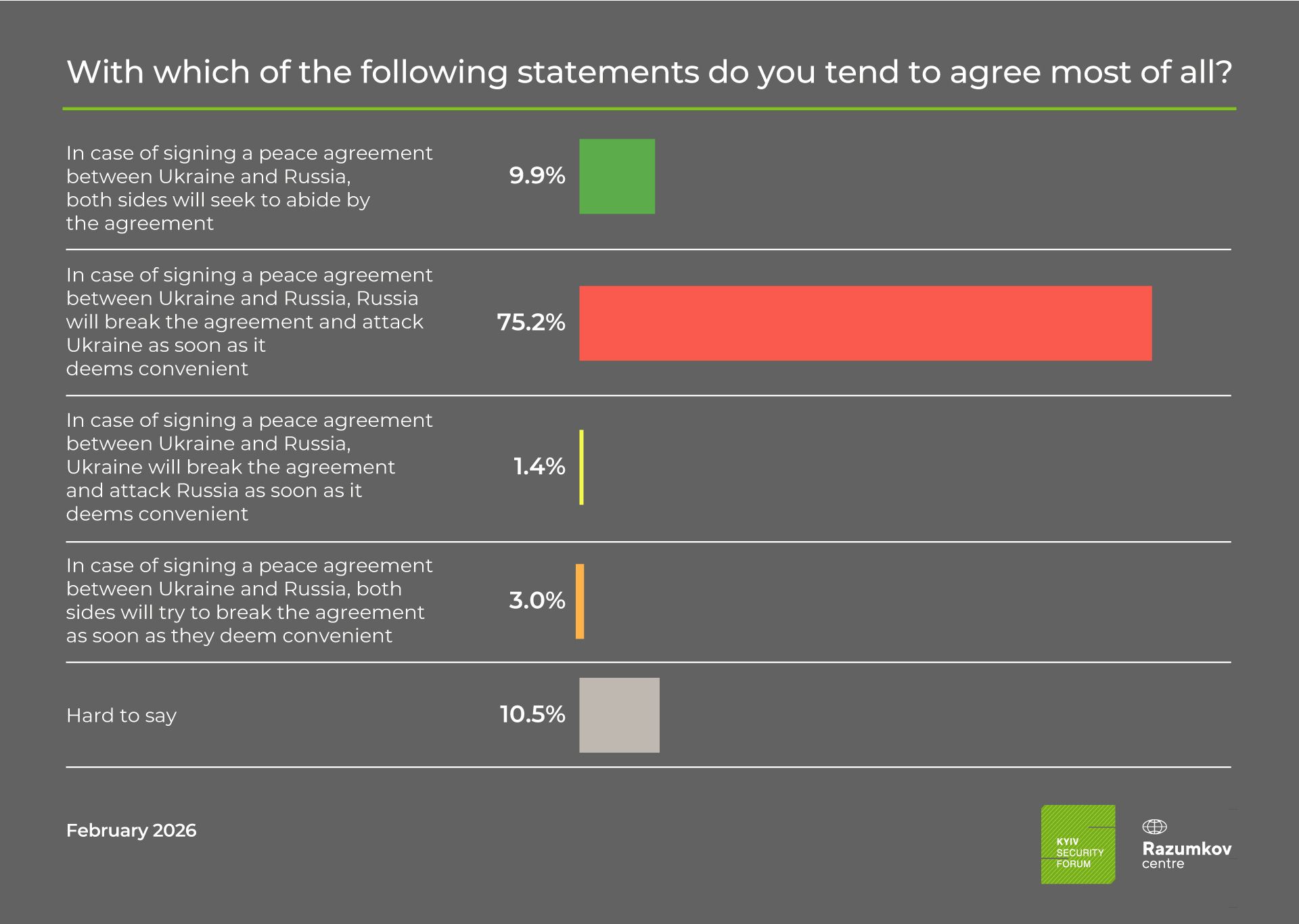
75.2% of respondents are convinced that if a peace agreement is signed, Russia will violate it and attack Ukraine as soon as it deems necessary.This is the highest figure recorded during the entire observation period. These are the findings of the survey commissioned by the Kyiv Security Forum and conducted by The Razumkov Center on the eve of the Munich Security Conference, which will take place on February 13-15.
The survey covers Ukrainians' expectations regarding the end of the war, their trust in the state, other countries and international institutions, as well as the resilience of households in the face of Russian attacks on energy infrastructure.
Distrust in peace agreements with Russia is growing
Respondents are sceptical about Russia's ability to comply with peace agreements. 75.2% of those surveyed believe that Russia will violate the agreement and attack Ukraine as soon as it deems necessary. 9.9% are convinced that both sides will try to comply with the terms of the peace agreement.
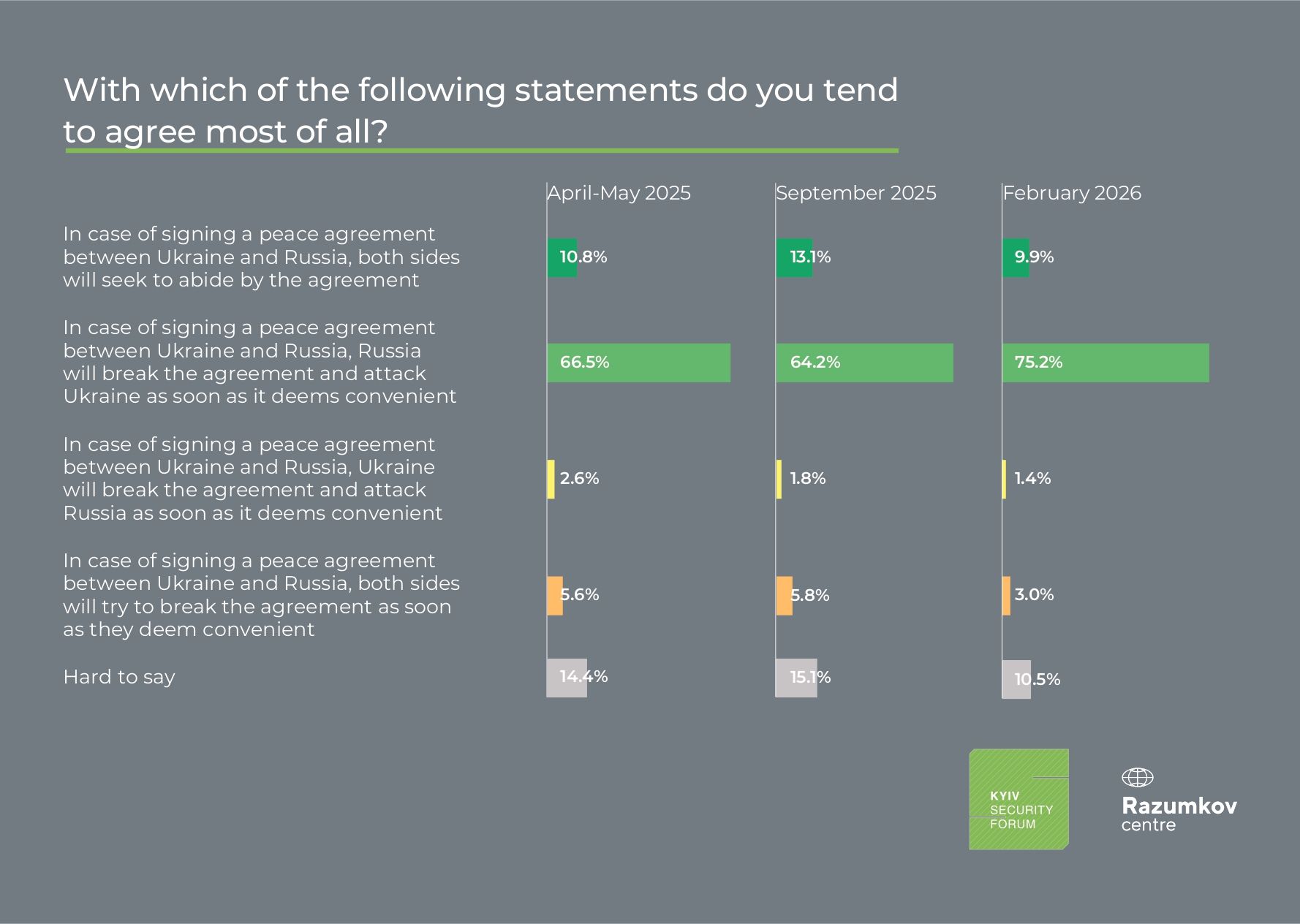
Compared to prior periods, distrust in potential peace agreements has increased. In April-May 2025, 66.5% of respondents held this view, while in September 2025, the figure was 64.2%. Thus, the indicator has increased by 8.7 percentage points since April-May 2025.
Continuation of Russian aggression after the withdrawal of troops from Donbas
More than two-thirds of Ukrainians (69.6%) are convinced that even if Ukraine withdraws its troops from the entire territory of Donetsk and Luhansk regions, Russia will continue its aggression. The opposite opinion is held by 19.6% of respondents, while 10.8% find it difficult to answer.
Minimum conditions for a peace agreement
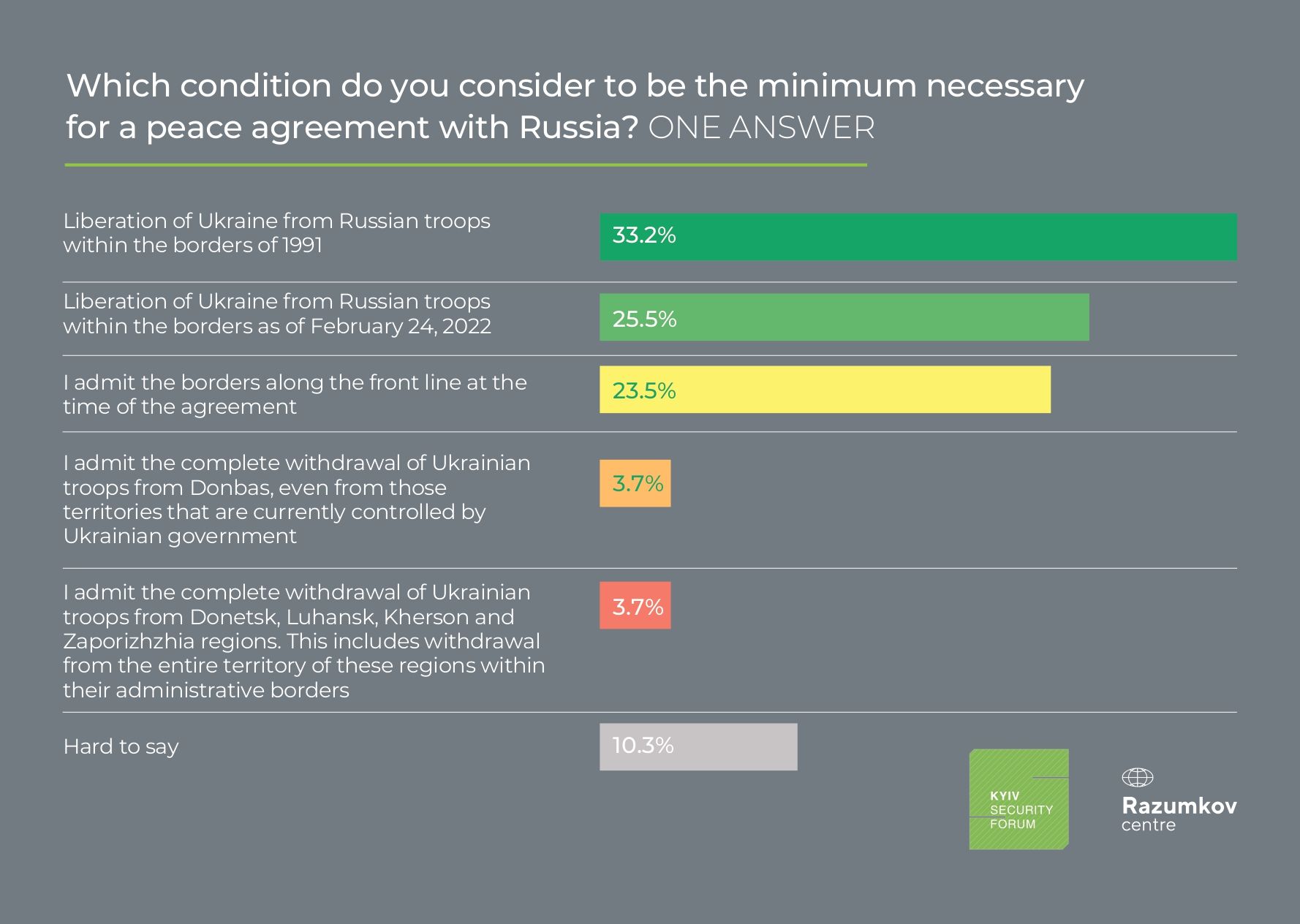
Ukrainians' opinions on the minimum conditions necessary for a peace agreement with Russia are divided. However, the majority – 33.2% of respondents – believe that Ukraine must be freed from Russian troops within the 1991 borders, while 25.5% believe it should be within the borders as of 24 February 2022.
Only 3.7% of respondents suggest the complete withdrawal of Ukrainian troops from the Donetsk, Luhansk, Kherson and Zaporizhzhia regions, and from the entire territory of these regions within their administrative borders.
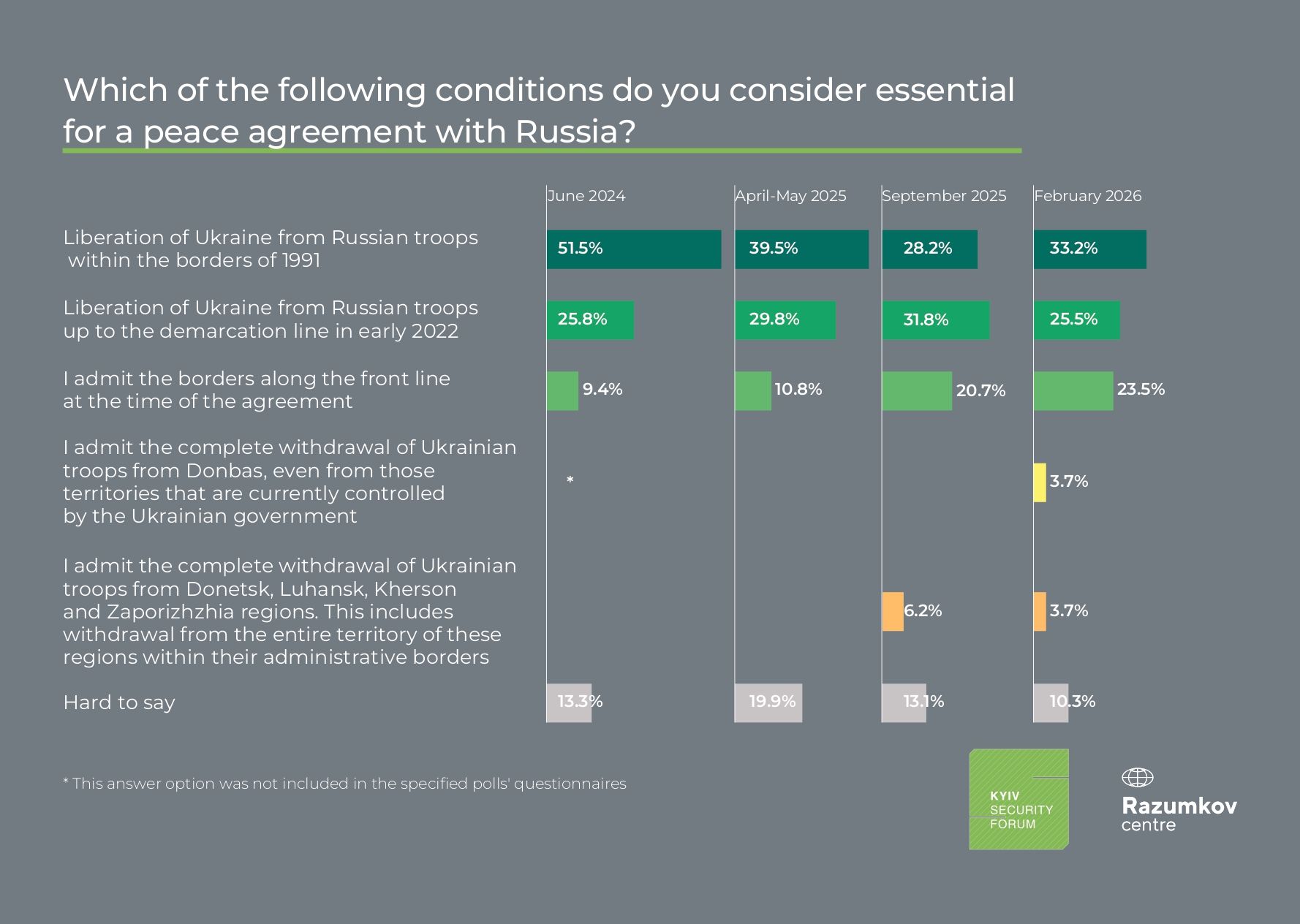
Compared to previous periods, the requirements for peace have changed. Support for a return to the 1991 borders has fallen from 51.5% in June 2024 to 33.2% in February 2026.
At the same time, the proportion of those who suggest fixing the borders along the front line has increased from 9.4% in June 2024 to 23.5% in February 2026.
Aspects of a peace agreement
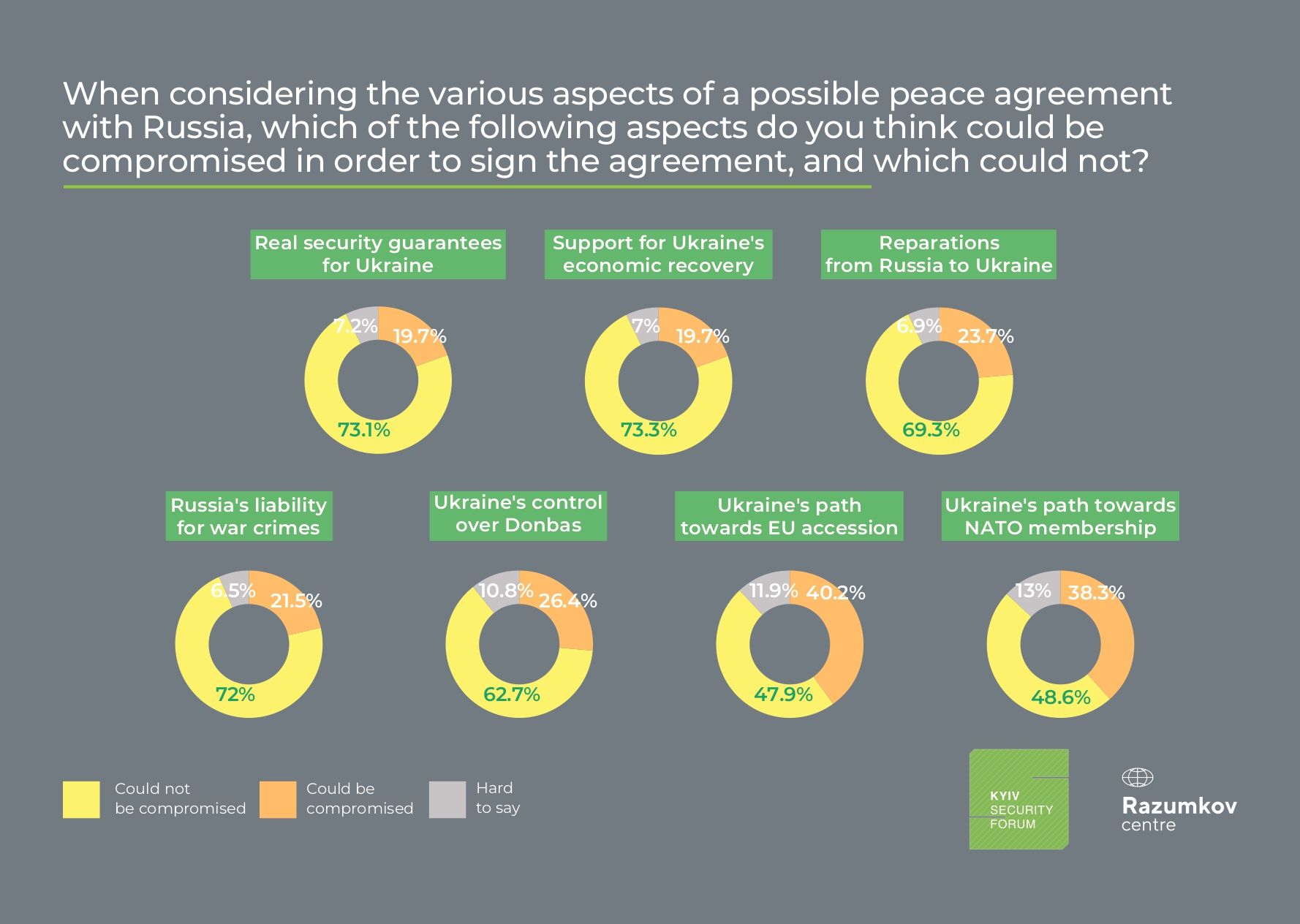
Respondents are categorically unwilling to compromise on key aspects of a possible peace agreement. 73.1% believe that Ukraine's real security guarantees cannot be compromised, 73.3% – assistance in Ukraine's economic recovery, 72% – Russia's responsibility for war crimes, 69.3% – the collection of reparations from Russia in favour of Ukraine.
Regarding territorial issues, 62.7% are convinced that Ukraine's control over Donbas cannot be compromised.
Opinions on Euro-Atlantic integration are almost evenly divided. 47.9% believe that Ukraine's course towards EU membership cannot be compromised, while 40.2% are open to such a compromise. Regarding NATO: 48.6% are not ready to compromise on this course, while 38.3% are willing to consider such an option.
The sociological survey was commissioned by the Kyiv Security Forum and conducted by The Razumkov Center on government-controlled Ukrainian territories from January 31-February 04, 2026, using phone interviews. A total of 1,003 respondents aged 18 and older living in all regions of Ukraine (except for the Autonomous Republic of Crimea) were interviewed. The survey was conducted among citizens who were in Ukraine at the time, in areas controlled by the Ukrainian government and covered by Ukrainian telephone operators. The structure of the sample population reflects the demographic structure of the adult population in the territories where the survey was conducted as of the beginning of 2022 (by macro-regions, age, gender, type of settlement). The theoretical sampling error does not exceed 3.2%.
 Ukraine, Kyiv, 01001